In 2026, Narrow Aisle Storage is becoming a practical response to expensive warehouse space, rising labor costs, and faster order cycles. Narrow aisles can release valuable floor capacity without requiring a larger building. Yet, the solution is not simply a matter of reducing aisle width.
MHI’s 2024 Annual Industry Report surveyed more than 2,000 supply chain professionals. It reported that 55% planned to increase technology investment. This supports stronger interest in reach trucks, articulated forklifts, warehouse management systems, and guided storage equipment. Gartner analyst Dwight Klappich has described the warehouse as “the new factory.” His observation highlights an important shift: storage design now affects productivity, accuracy, and customer service.
For global buyers, the best system must match the building and the people using it. A 1.8-meter aisle may improve density, but it can restrict turning space, visibility, or emergency access. Rack height matters too. So does floor flatness. Small errors become expensive at twelve meters above ground.
This guide compares the top Narrow Aisle Storage solutions expected to attract global buyers in 2026. It examines reach trucks, very-narrow-aisle systems, mobile racking, automation, safety controls, and total ownership costs. The analysis also considers regional service support and operator training. Numbers can look impressive. Real warehouses are less obedient. A high-density layout may reduce travel distance while increasing maintenance complexity. Careful site testing remains essential.
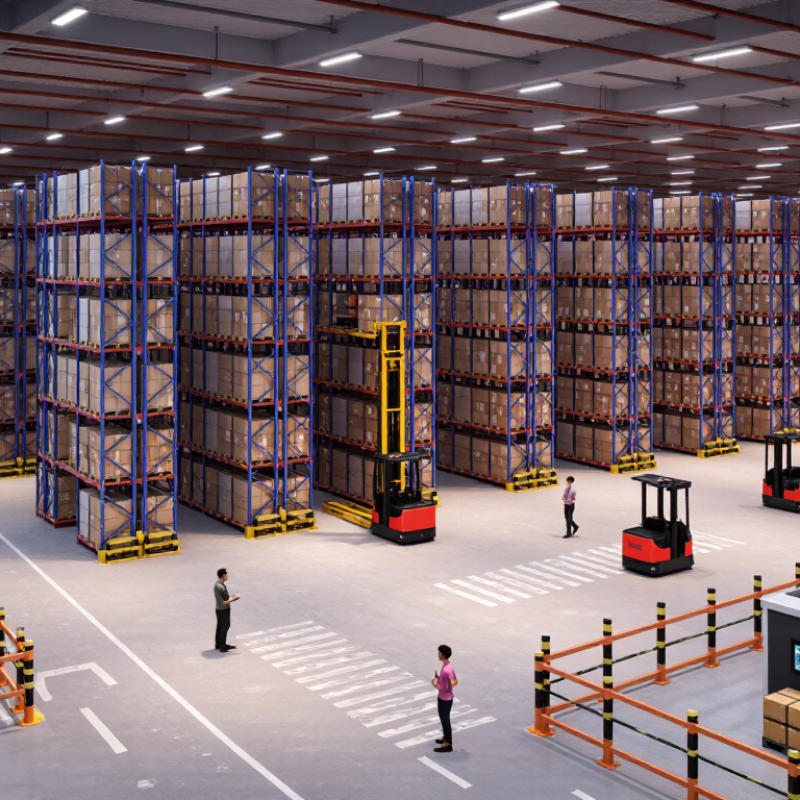
Narrow aisle storage means placing pallet racks closer together than conventional layouts, often within 1.8 to 2.7 metres. Very narrow aisle systems may require guided vehicles or turret trucks. The main types include selective narrow aisle racks, double-deep racks, and very narrow aisle systems. Each option changes access speed, storage density, and equipment cost. MHI’s 2024 Annual Industry Report found that 55% of respondents expected higher technology investment within two years. That trend supports smarter aisle planning for 2026 buyers.
Applications vary across global markets. E-commerce warehouses need fast picking and frequent replenishment. Cold stores value compact layouts because chilled floor space is expensive. Urban facilities often use narrow aisles to increase capacity without expanding the building. However, density is not always efficiency. A design may look excellent on paper but create slower travel and difficult emergency access. Floor flatness, rack height, pallet dimensions, local fire requirements, and service availability need equal attention. MHI also reported that 88% of respondents viewed digital supply chain technology as a competitive advantage.
Tips: Measure real pallet flow before choosing a rack type. Reserve clearance for turning and maintenance. Test the busiest picking route. Ask suppliers for load calculations and floor-tolerance data. A small pilot area can expose hidden delays. It may feel slower at first, but honest testing prevents expensive redesigns.
Global buyers are reconsidering aisle width as warehouse costs rise. The practical comparison is 1.8–2.5 metres for narrow aisles versus 3.0–3.7 metres for standard layouts.
A 1.8-metre aisle can increase pallet density, but only with suitable reach equipment, stable loads, and accurate driver training. At 2.2–2.5 metres, operators gain more tolerance around pallet edges and turning movements. Standard aisles, usually 3.0–3.7 metres, support faster two-way traffic and easier mixed-equipment operation. Narrower is not automatically better. A 2024 MHI industry report found that 55% of supply-chain organisations cited workforce shortages, making simpler, safer workflows increasingly important. In practice, one damaged pallet or repeated alignment correction can erase the expected space savings.
Purchasers should compare usable storage positions, not floor density alone. Measure pallet overhang, rack beam clearance, forklift turning radius, fire access, and pedestrian separation.
OSHA 29 CFR 1910.176 requires clear, safe aisles, while EN 15635 supports regular inspection of storage systems. These rules do not approve one universal width. Local regulations and equipment specifications still govern the final design.
WERC’s 2024 DC Measures benchmarking also keeps space utilisation and labour performance linked, which is often overlooked during procurement. Leave room for error. A design that works perfectly in a drawing may feel restrictive during a busy shift.
2026 Top Narrow Aisle Storage Solutions for Global Buyers
Narrow aisles can increase storage capacity by up to 50%, but the result depends on layout, equipment, and building limits. A 3.0-meter aisle may shrink toward 1.8 meters with suitable reach trucks or very-narrow-aisle equipment. That change can add pallet positions without expanding the warehouse footprint. It also creates tighter turning zones, stricter floor requirements, and less tolerance for operator error.
The 2024 MHI Annual Industry Report found that 55% of surveyed supply-chain professionals use cloud computing. This matters because narrow-aisle projects need accurate location data, live inventory updates, and disciplined slotting. The 2024 Global Warehousing Study by Zebra reported that 73% of warehouse decision-makers expect to increase modernization efforts by 2029. Yet technology alone cannot repair poor measurements. A six-centimeter survey error can disrupt rack alignment across a long bay.
Practical planning should compare current pallet positions, fire-clearance rules, ceiling height, and truck operating costs. Measure the floor before selecting racks. Check battery charging areas, emergency access, and local safety requirements. The 50% gain is possible, not guaranteed. In some facilities, a 20% increase may produce better throughput than maximum density. This is where many proposals become too optimistic. Density without fast, safe retrieval can turn into expensive congestion.
| Storage Solution | Typical Aisle Width | Typical Storage Height | Approx. Pallet Capacity Gain* | Selectivity | Best-Fit Applications | Key Planning Requirement |
|---|---|---|---|---|---|---|
| Conventional selective pallet racking | 3.0–3.7 m | Up to approximately 10 m | Baseline | Very high | High SKU variety, frequent pallet access, mixed inventory | Standard counterbalance or reach-truck operating clearances |
| Narrow aisle selective racking | 2.0–2.7 m | Approximately 8–12 m | 20–35% | Very high | Distribution centers requiring direct access to most pallets | Reach trucks or specialized narrow-aisle trucks; accurate floor layout |
| Very narrow aisle (VNA) racking | 1.5–1.8 m | Approximately 10–18 m | 30–50% | Very high | High-throughput warehouses with high ceilings and many pallet positions | Guidance system, specialized VNA truck, smooth floor and tight tolerances |
| Double-deep pallet racking | 2.8–3.5 m | Approximately 8–12 m | 20–40% | Medium | Lower SKU counts with multiple pallets per SKU | Reach truck with sufficient lift capacity and extended reach depth |
| Pallet flow racking | 3.0–3.7 m | Approximately 6–10 m | 30–60% | Medium to high | FIFO inventory, food, beverage and temperature-controlled operations | Consistent pallet quality, controlled loading and dedicated replenishment lanes |
| Drive-in / drive-through racking | 3.2–3.8 m | Approximately 6–10 m | 50–80% | Low to medium | Very high-volume, low-SKU, last-in-first-out storage | Uniform pallets, disciplined loading sequence and impact protection |
| Mobile pallet racking | One active aisle, typically 3.0–3.7 m | Approximately 6–12 m | 50–100% compared with fixed aisles | High | Cold storage, archival inventory and space-constrained facilities | Reinforced floor, safety interlocks, seismic review where applicable |
| Automated pallet crane system | Approximately 1.5–2.0 m | Up to approximately 40 m, project-dependent | 40–100% compared with conventional layouts | High | High-volume operations seeking labor reduction, traceability and vertical utilization | High initial investment, warehouse-management integration and fire-safety engineering |
Reach trucks are becoming central to narrow aisle storage in 2026, especially where buildings use high vertical space. Models designed for lifting heights between 8 and 13 metres can increase pallet capacity without expanding the warehouse footprint. Yet height alone should not decide the purchase. Load weight, residual capacity, pallet dimensions, aisle width, floor quality, and racking design must be checked together.
In practical warehouse assessments, operators often focus on maximum lift height first. That assumption fails. A truck may reach 13 metres, but its safe capacity can decline at higher elevations. Ask for capacity charts at the intended load centre and lift height. Check mast deflection, fork visibility, steering response, and stability during retrieval. Visibility changes everything. Bright lighting helps, but it cannot correct poor rack alignment or damaged pallets.
Battery selection also affects daily performance. High-use operations may need opportunity charging, spare batteries, or carefully planned charging areas. Cold stores require suitable components and reduced stopping time. Safety features should support controlled speed, emergency braking, overhead protection, and operator training. Small errors matter. A few centimetres of pallet overhang can create contact risks in a tight aisle. Trial the equipment with real pallets, real aisle conditions, and experienced operators before approval. The first choice may still need revision after observing a full shift.
2026 Top Narrow Aisle Storage Solutions for Global Buyers
For global buyers, narrow aisle storage should begin with verified load ratings, not maximum capacity claims. Each upright, beam, and floor anchor must match the specified pallet weight, bay height, and handling equipment. A 1,000-kilogram pallet changes the design completely when stored at six meters. Request stamped calculations, test records, and installation tolerances. Small documentation gaps can become expensive surprises.
EN 15635 requires racking users to manage safe operation, regular inspections, and documented damage control. An expert inspection should occur at intervals not exceeding twelve months. Weekly visual checks are also practical in busy warehouses. MHI’s 2024 Annual Industry Report reported that 55% of supply chain professionals were increasing technology investment. Yet automation does not automatically create a good return. Measure travel distance, pallet movements per hour, labor hours, downtime, and training costs before approving a solution.
A credible ROI model includes steel, guards, anchors, installation, aisle redesign, permits, maintenance, and future expansion. It should also price lost capacity during installation. The cheapest frame may demand more repairs. That weakens the business case. Interact Analysis has forecast strong global growth in warehouse automation through 2027, but market growth is not proof of individual savings. Buyers should compare three-year and ten-year total cost scenarios, using local labor, energy, inspection, and replacement rates. Real warehouse data matters more than a polished quotation.
It places pallet racks closer together than conventional layouts. Typical narrow aisles measure 1.8 to 2.7 metres. Very narrow systems may require guided vehicles or turret trucks.
Common types include selective narrow aisle racks, double-deep racks, and very narrow aisle systems. Each affects access speed, storage density, and equipment cost.
Narrow aisles usually measure 1.8 to 2.5 metres. Standard aisles commonly measure 3.0 to 3.7 metres. Narrow designs hold more pallets, while standard layouts support easier two-way traffic.
No. It needs suitable reach equipment, stable pallet loads, and accurate driver training. Pallet overhang or repeated alignment corrections can erase space savings.
E-commerce warehouses may gain faster access and frequent replenishment capacity. Cold stores benefit because chilled floor space is expensive. Urban facilities can increase capacity without expanding the building.
Measure real pallet flow, overhang, beam clearance, turning radius, and maintenance space. Check floor flatness and pallet dimensions. Test the busiest picking route.
Yes. Dense layouts may create slower travel or difficult emergency access. A drawing may look excellent but feel restrictive during a busy shift. Not always better.
Build a small pilot area before full installation. Ask for load calculations and floor-tolerance information. Reserve clearance for turning, maintenance, fire access, and pedestrian separation. Our first estimate may be wrong. That is useful to discover early.
Narrow Aisle Storage is a practical solution for warehouses that need greater capacity without expanding their building footprint. By reducing aisle widths to approximately 1.8–2.5 meters, compared with the 3.0–3.7-meter range of standard layouts, businesses can improve space utilization and potentially increase storage capacity by up to 50%. Common configurations include selective narrow-aisle racking, high-density pallet storage, and systems designed for precise handling in restricted operating areas.
For global buyers, equipment and safety planning are essential. Reach trucks are often suitable for lifting loads to heights of 8–13 meters, but selection should also consider pallet dimensions, load ratings, battery performance, floor conditions, and operator visibility. Buyers should evaluate compliance with EN 15635 safety principles, installation quality, maintenance requirements, training needs, and long-term return on investment. A complete total-cost analysis can help balance initial spending with productivity, storage density, energy use, and future operational flexibility.

Sanyang Racking